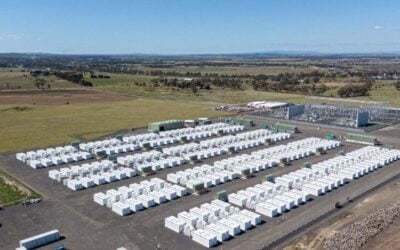
Construction has kicked off at the largest battery project in Australia to date, with a storage capacity equivalent to that of the entire country’s fleet of projects under construction at the end of 2022.
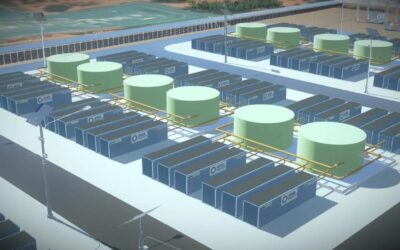
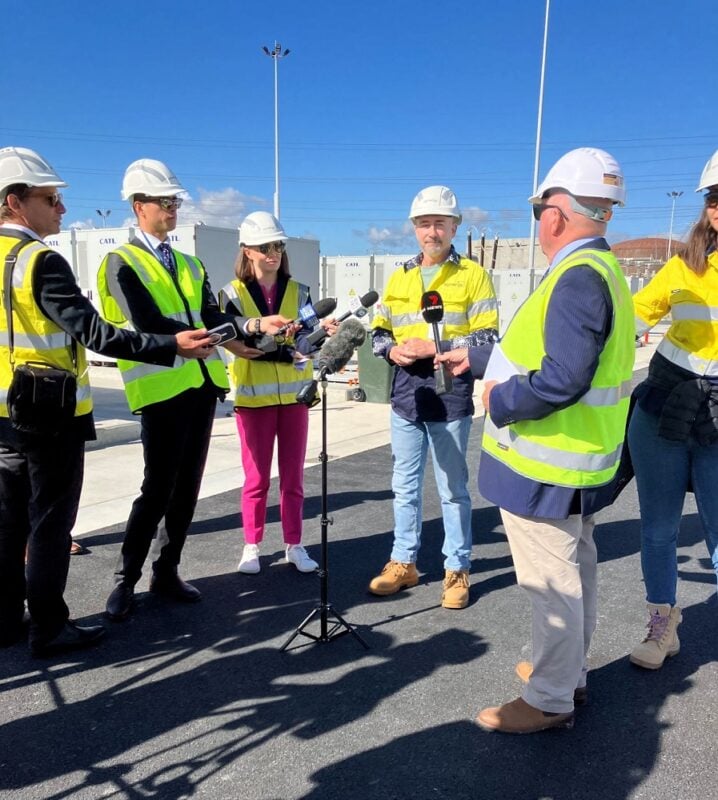
The government of Western Australia (WA) announced last week (15 March) that the construction phase has begun at Collie, a battery energy storage system (BESS) project with 500MW output to the grid and 2,000MWh energy storage capacity.
The state’s government is funding the project. It forms part of the government’s commitment to increasing the amount of storage available for when variable renewable energy (VRE) sources, like solar PV and wind, aren’t generating, and in managing peak loads and congestion on the grid.
It’s being added to the growing portfolio of state-owned energy generator-retailer (‘gentailer’) Synergy. Synergy is looking to deploy 3GWh of energy storage from batteries by 2025.
Try Premium for just $1
- Full premium access for the first month at only $1
- Converts to an annual rate after 30 days unless cancelled
- Cancel anytime during the trial period
Premium Benefits
- Expert industry analysis and interviews
- Digital access to PV Tech Power journal
- Exclusive event discounts
Or get the full Premium subscription right away
Or continue reading this article for free
With the Collie BESS set to be completed by the end of that year, the energy supplier is well on the way to reaching that target. Construction began in mid-2023 on Kwinana 2, a 200MW/800MWh BESS project that will complement Kwinana 1 (100MW/400MWh), which was completed in May last year.
“The build of Australia’s biggest battery right here in Collie marks a significant point in the energy transition,” said Member of the Legislative Assembly (MLA) for the local Collie-Preston electoral district Jodie Hanns.
Hanns noted the historical importance of the Collie region to WA’s energy system, being host to many of its large-scale thermal generation plants, including a Synergy-owned coal power plant at Collie itself scheduled for decommissioning in 2027 and another already retired coal, fuel oil, and gas power station at Kwinana.
Further underscoring the site’s significance is the proposed development by privately-owned French independent power producer (IPP) Neoen of another large-scale BESS at Collie. Neoen has said the sizing of its asset would be 200MW/800MWh but could later be expanded to 1GW/4GWh. Synergy has also said it could expand the Collie project to 1GW/4GWh, if enabled by market conditions.
WA Minister for Energy Reece Whitby noted that the battery project will also help “local workers and families” as Collie sees the exit of thermal generation.
Planning approval was granted for the Collie BESS in December. That followed a government announcement in September that Chinese battery maker CATL will supply the BESS for both it and Kwinana 2, with Spain-headquartered Power Electronics to provide power conversion system (PCS) equipment to the projects.
Up to 96GWh of storage needed in region by 2050
Western Australia is not part of the National Electricity Market (NEM) that connects Australian states in the southern and eastern parts of the country.
Energy is instead traded and balanced instead through Wholesale Electricity Market (WEM) for the South West Interconnected System of Western Australia (SWIS) grid network.
While the NEM was recently highlighted as being among the world’s most volatile electricity markets in terms of pricing by Rystad Energy, and most of the country’s BESS capacity is being installed in NEM-connected states such as Victoria and New South Wales (NSW), the need for storage in the SWIS, which is an isolated grid, is also very large.
The Australian Energy Market Operator (AEMO) has modelled that WA will need between 12GW and 17GW, and between 74GWh and 96GWh of storage by 2050.
National significance of project’s scale and duration
A report published earlier this month by Australian trade association Clean Energy Council (CEC) found that, as of the end of 2022, there were 19 large-scale BESS projects totalling 1.4GW and 2GWh under construction throughout the country.
The report, ‘Clean Energy Australia 2023’, recapped project activities including construction and investment commitments across wind, solar and energy storage last year, providing the 2022 figures by way of comparison with 2023’s “significant year” for storage.
It’s boom time for batteries, which, along with rooftop solar PV, provided a bright spot in an otherwise challenging market environment for renewables in Australia, CEC said. As of the end of 2023, there were 5GW/11GWh of big BESS projects in construction.
The largest of those was the Waratah Super Battery in New South Wales (850MW/1,680MWh), making WA’s claim to the single biggest project underway so way valid, although it looks likely more on a similar scale will come.
Waratah Super Battery, also due to go into operation in 2025, has a larger grid output capacity in megawatts than the Collie BESS. However, the bigger megawatt-hour figure and 4-hour duration of Synergy’s BESS at Collie is also significant in a market that has, to date, seen battery storage going from 1-hour to 2-hour duration for most large-scale projects.
Energy-Storage.news’ publisher Solar Media will host the 1st Energy Storage Summit Australia, on 21-22 May 2024 in Sydney, NSW. Featuring a packed programme of panels, presentations and fireside chats from industry leaders focusing on accelerating the market for energy storage across the country. For more information, go to the website.